
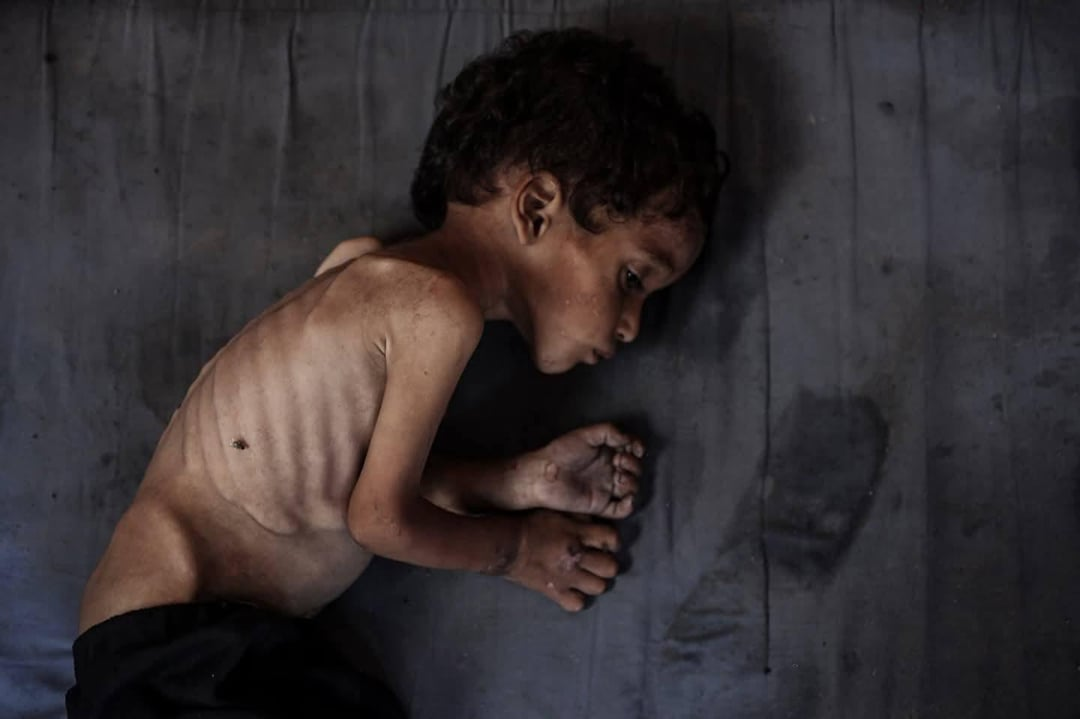
Gaza’s hunger crisis has torn deeply into the lives of its people. This is not a natural disaster. Instead, it is a deliberately created famine designed to crush their will to resist and fight. In 2025, more than two million Palestinians are starving. An Israeli blockade has cut off food, water, and medicine with calculated precision. The Ummah grieves for Gaza. However, its so-called leaders’ failure to open the borders has become a bitter betrayal. This is not just a political issue. It is a human tragedy. Children and adults are wasting away, while world leaders continue to uphold the very policies that caused this catastrophe.
In Al-Shati refugee camp, 18-month-old Muhammad al-Mutawaq lies weak in his mother Hidaya’s arms. His body weighs less than 4 kilograms. His ribs are visible, and his wide, hollow eyes show the hunger that now haunts Gaza’s children. Hidaya, a 30-year-old widow displaced by war, cannot breastfeed. Her own body has been drained by starvation. She walks from hospital to hospital, searching for milk but finding only water. As a result, doctors at Nasser Hospital warn that Muhammad could suffer permanent damage to his brain and muscles. Thousands of children are facing the same danger. According to NPR and The New York Times (July 2025), one in five children in Gaza City suffers from acute malnutrition.

In Khan Younis, two-year-old Yazan Abu Ful sits motionless in his family’s damaged home. His thin, wasted body was photographed by AFP on 23rd July 2025. His mother, Naima, scours the markets but finds only empty shelves or food priced far beyond reach. Consequently, Yazan, once a cheerful toddler, now faces stunted growth and permanent health complications. UN data shows that 71,000 children under five are suffering from acute malnutrition. Among them 14,100 are close to death. Yazan’s photos calls out to a world that continues to look the other way.

This famine spares no one. Alongside women and children, young men are also dying under its unrelenting grip. On 31st July 2025, 27-year-old Adil Mazi died of hunger in Khan Younis. Months of starvation reduced his body to skin and bones. Before the war, Gaza received 500 aid trucks a day. Today, Israel allows only 28 to enter. Adil’s slow death reveals the cruelty behind this blockade. His story, therefore, joins those of Gaza’s children in a growing cry for immediate help.

The Ummah feels Gaza’s pain. Even so, it has failed to act and help. So-called leaders of Muslim nations speak words of solidarity but refuse to act. Instead, they aid the oppressors and demand that Palestinians disarm and abandon their resistance. They do not open the borders. They do not send food. Their armies, their weapons, their wealth remain unused. Allah commands the believers to protect the oppressed, yet few rise to defend them. As a result, Gaza remains trapped in a web of broken promises and empty words.
Israeli officials no longer hide their intentions and in truth they never did. In July 2025, Heritage Minister Amichai Eliyahu told Israeli radio: “The day they return the hostages, there will be no hunger there.” His statement makes it clear. Israel is using starvation to pressure the fighters, even if millions of civilians must suffer. Just days later, Finance Minister Bezalel Smotrich described the blockade as a strategic move to prevent aid from reaching Hamas. He admitted that this policy is designed to weaken the group by inflicting hardship on the civilian population. The New York Times and Al Jazeera both reported these remarks, exposing a strategy that deliberately turns hunger into a weapon.

Meanwhile, 6000 aid trucks sit outside Gaza’s borders. Only a small number are allowed in. Gaza once received 500 trucks a day. Now it receives fewer than 30 trucks. False claims regarding what happens to the aid have made this crisis even worse. Israeli and Western officials often accuse Hamas of stealing aid. However, a leaked USAID report, cited by Reuters, found no evidence of systematic theft. The United Nations and World Health Organization both describe this as a man-made famine. Since May 2025, Israeli forces have killed more than 1000 Palestinians near aid sites, according to the UN Human Rights Office. Governments speak of temporary humanitarian pauses. Yet those pauses often end in bloodshed. On 28th July, Israeli forces killed 25 Palestinians, including four children, as they tried to reach food. Imagine enduring months of relentless hunger, only to be shot and killed while desperately seeking a scrap to survive…

Muhammed, Yazan, and Adil’s stories do not stand alone. Instead, they resonate throughout Gaza. Every day brings more suffering, more dead bodies and more shattered lives. Bodies weaken. Hope slips away. The Ummah must act with real action. It must open the borders. It must deliver the aid. It must confront the leaders and governments who are enabling Israel while it starves civilians. This silence must end. These policies must end. Gaza does not need pity. It needs help. Now!
If the Ummah chooses to remain silent and inactive, the memory of these men, women, and children will linger among us not just as a source of sorrow, but as a haunting reminder that we witnessed their suffering and turned away.