
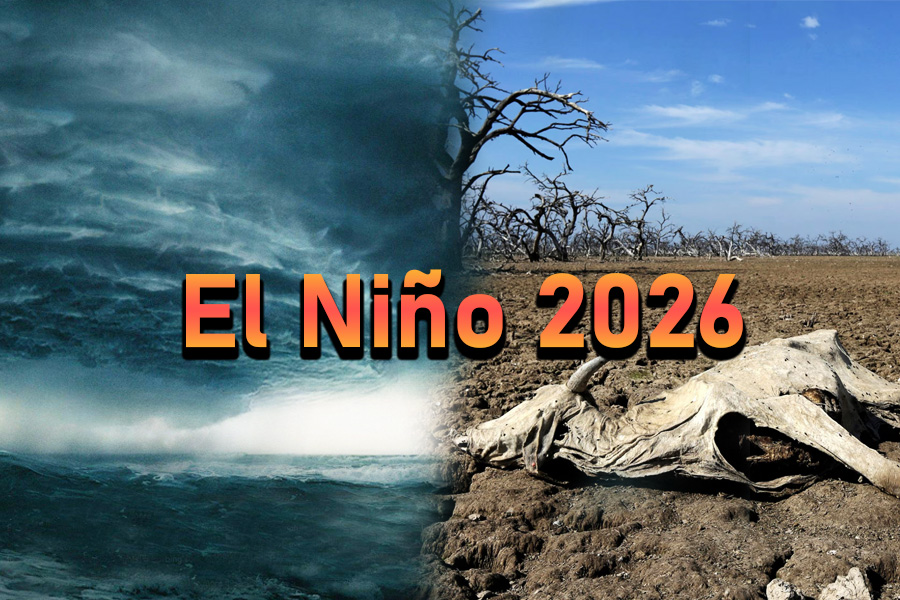
For the past few days, dramatic headlines have been spreading online claiming that Earth’s “most dangerous climate cycle” has officially started. Many posts warn that a massive El Niño could bring global chaos, food shortages, and extreme weather across the planet. Some of these claims are exaggerated. But the concern itself is real.
Scientists are closely monitoring the Pacific Ocean because climate models are increasingly showing signs that a strong El Niño may develop during late 2026. Some forecasts even suggest it could become a “Super El Niño,” similar to some of the strongest events ever recorded.
So what exactly is El Niño? And why does the world pay so much attention to it?
What Is El Niño?
El Niño is a natural climate pattern that happens when the surface waters of the central and eastern Pacific Ocean become unusually warm. “El Niño” is a Spanish word, meaning “Little Child”.
Normally, trade winds push warm water westward across the Pacific, allowing colder water from deeper parts of the ocean to rise near South America. During an El Niño event, those winds weaken and warm water spreads eastward across the Pacific. This change affects the atmosphere and begins altering weather patterns around the world. Even though it starts in the Pacific Ocean, El Niño can influence rainfall, monsoons, hurricanes, droughts, floods, fisheries, coral reefs, and agriculture across multiple continents. Some regions become wetter than normal, while others experience severe dryness and extreme heat.

Why Scientists Are Concerned About 2026
Climate agencies and forecasting models are now showing increasing chances of El Niño forming later in 2026. Some computer models suggest the warming in the Pacific Ocean could become exceptionally strong, which is why some researchers and weather analysts are using the term “Super El Niño.”
The world has seen several major Super El Niño events before, especially during 1982 to 1983, 1997 to 1998, and 2015 to 2016. These events caused severe floods, droughts, coral bleaching, wildfires, crop damage, and major economic losses in different parts of the world.
One of the most devastating El Niño periods in recorded history occurred during 1877 to 1878. That event contributed to widespread droughts and famines across parts of Asia, Africa, and South America. Millions of people died during that period, although historians also explain that colonial policies, food exports, and poor governance made the disaster far worse.
Scientists are paying close attention now because global ocean temperatures are already unusually warm due to long term global warming. If a strong El Niño develops on top of these already elevated temperatures, it could intensify extreme weather conditions even further.
What Could Happen if a Strong El Niño Develops?
It is important not to fall into fear or online sensationalism because no climate model can predict every outcome perfectly months in advance.
However, based on previous El Niño events, scientists expect that many regions could experience stronger heat waves and unusually high temperatures. Some countries may face heavy rainfall and flooding, while others could experience droughts severe enough to damage crops and water supplies.
Marine ecosystems may also suffer. Warmer oceans place heavy stress on coral reefs, often causing widespread coral bleaching. For island nations like the Maldives, this matters greatly because coral reefs protect coastlines and support marine life and fisheries.
Ocean temperature changes can also affect fish migration and disrupt marine food chains, creating problems for fishing industries and coastal communities that depend on the sea for food and income.
Is the Situation Being Exaggerated Online?
In many cases, yes. Some viral posts claim that the event has “officially started” or that “systemic collapse” is highly likely. That is not how scientists normally communicate climate forecasts.
At the moment, El Niño has not fully developed yet. Researchers are still monitoring ocean temperatures, wind patterns, and atmospheric conditions across the Pacific Ocean. There is also uncertainty in climate forecasting. Some models predict a very strong event, while others show more moderate outcomes. This means the situation should be taken seriously, but not treated like an apocalypse.
Why Preparation Matters
Even though uncertainty remains, preparation is still extremely important. Modern societies are far more advanced than they were during the nineteenth century. Today the world has satellites, ocean monitoring systems, seasonal forecasting, international communication networks, disaster response systems, and global food trade. These tools help communities respond earlier and reduce the impact of extreme climate events.
Still, strong El Niño events can place heavy pressure on agriculture, infrastructure, energy systems, fisheries, healthcare, and water supplies. Countries that prepare early usually handle these disruptions far better than those that ignore the warnings.
Final Thoughts
The Pacific Ocean may be entering the early stages of a significant El Niño event for 2026, and scientists are watching the situation closely because strong El Niño conditions can disrupt weather patterns across the world.
But it is important to separate real science from online fear campaigns. A major El Niño does not automatically mean global collapse. At the same time, ignoring the risks completely would also be unwise.
The most realistic approach is awareness, preparation, and understanding how deeply connected Earth’s climate systems truly are.