
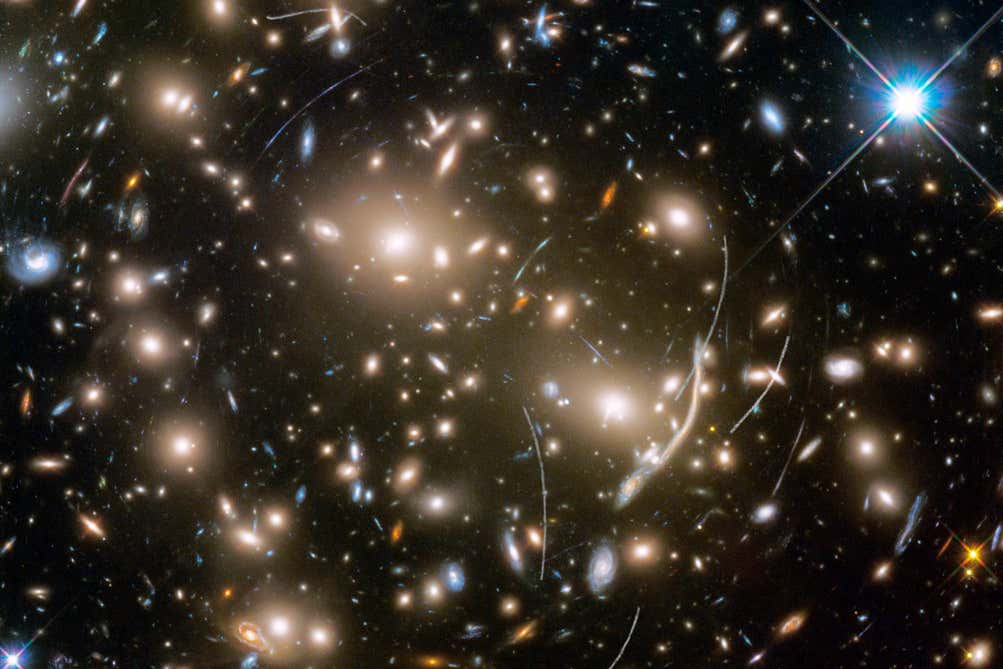
The farthest edge that modern telescopes can reach is known as the edge of the “observable universe”. It’s not the end of the universe itself. But it’s just the farthest limit of what we are physically able to see. Beyond that point, light hasn’t had enough time to reach us since the beginning of creation, making it physically impossible to observe anything further. This isn’t only a limitation of modern tools, but also a limit set by Allah in the (Universal) laws of physics.
This edge forms a kind of cosmic bubble around us, stretching about 46.5 billion light-years in every direction. That’s the farthest distance from which light has had time to reach Earth since the universe began, approximately 13.8 billion years ago.
What lies within this observable universe is a scale of creation beyond anything the human mind can truly grasp. There are an estimated 2 trillion galaxies in the observable universe. Each galaxy contains anywhere from millions to trillions of stars. And many of those stars are surrounded by planets that are absolutely breath-defying. Our own Milky Way holds over 100 billion stars. The nearest galaxy to us, Andromeda (2.5 million light years away) holds nearly a trillion stars. And scattered across this vast universe could be sextillions of planets… that’s a 1 followed by 21 zeroes!
So far only around 5000 exoplanets (planets that are orbiting other stars) have been physically discovered, and this is just the tip of the iceberg. With every new telescope, we see deeper and wider into the cosmos, but the edge (or the limit) always remains, because the universe is expanding.
Allah says in the Qurān: “And the heaven We constructed with strength, and indeed, We are [its] expander.” [Surah Adh-Dhariyat, 51:47]
The Qur’an spoke about the expansion of the universe over 1,400 years ago, long before modern astrophysics was even born. Yet it was only in the last century that science finally caught up and witnessed this truth with its own eyes. Today, cosmologists agree that space itself is expanding, causing galaxies to drift farther apart over time. The more we observe, the more we find that Allah’s creation is not static. It’s alive, moving, and growing.
This realization should no doubt humble us. We are barely a speck in this vast ocean of galaxies. And yet, in this grand system, every law, every atom, every light beam follows a precise order set by the Creator, Allah.
Allah says in the Qur’an: “Indeed, the creation of the heavens and the earth is greater than the creation of mankind, but most of the people do not know.” [Surah Ghafir 40:57]
He also says: “Do they not look at the sky above them — how We built it and adorned it, with no rifts in it?” [Surah Qaf 50:6]
So next time you gaze at the night sky, know this. The observable universe is just the visible part of Allah’s creation. Beyond it lies what only He knows. What we’re seeing is not just science. It’s a sign.
Allah says in the Qur’an: “Indeed, in the creation of the heavens and the earth are signs for people who reflect.” [Surah Aal-Imran 3:190]