
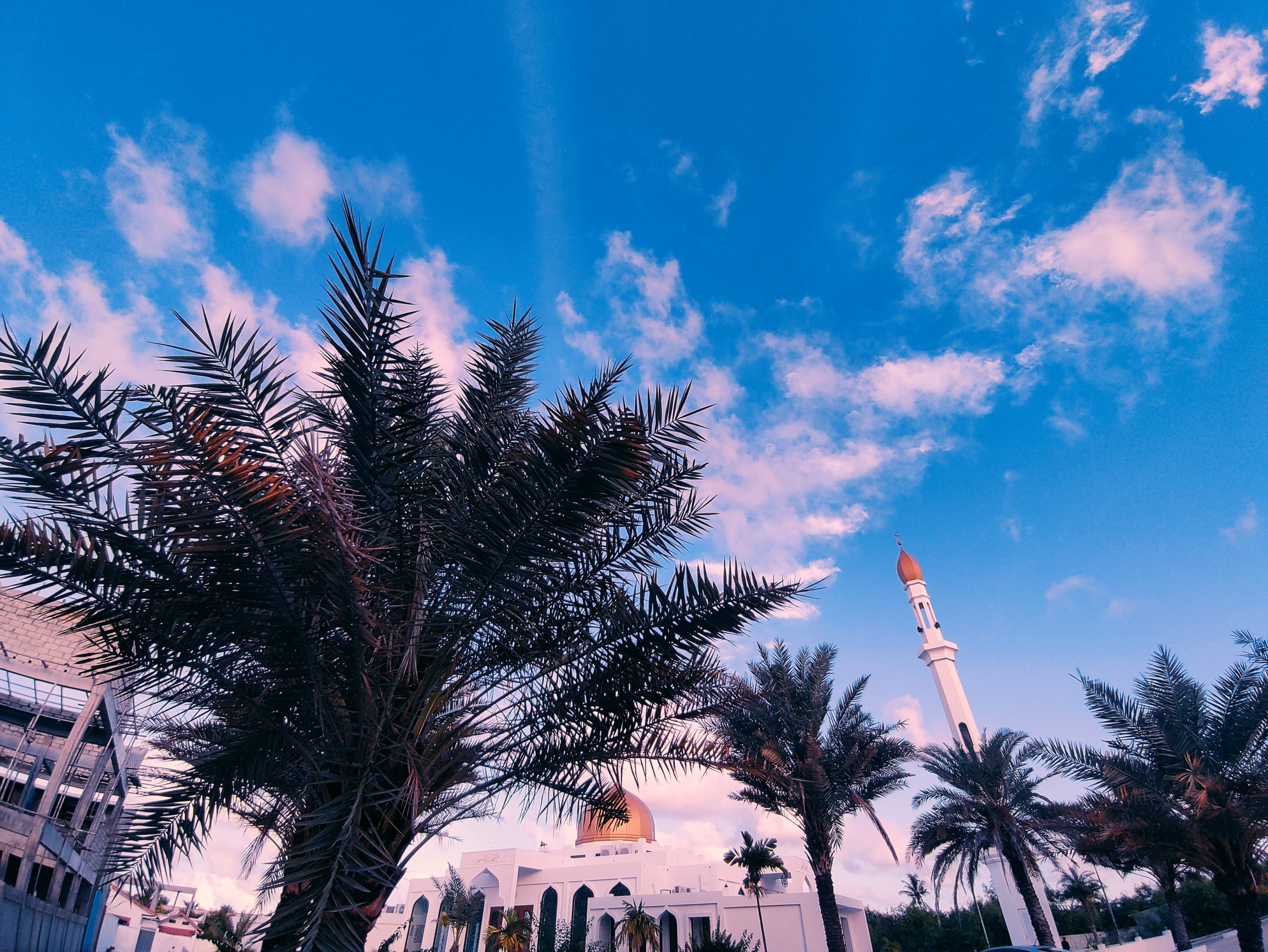
The recent introduction of date palms in public spaces across the Maldives, including Malé and the new terminal at Velana International Airport, has sparked both appreciation and criticism. While many see this as something beautiful and meaningful, others, especially from secular circles, consider the trees as a symbol of “Arabification” or as foreign to Maldivian culture. This kind of criticism is biased and represents a narrow and inaccurate perspective. Especially among secular-minded individuals, there is often a visible discomfort when faced with anything that reflects Islamic values or even elements of Arabic culture.
Ironically, many of those who pretend to advocate for “national identity” and “cultural uniqueness” remain silent (or even supportive) when it comes to Western cultural influences, such as liberal tourism policies allowing alcohol consumption on resort islands and the normalization of non-Islamic social norms.
The date palm, in this context, is criticized not because it is foreign, but because it symbolizes a connection to the broader Islamic world. For a nation whose population is Muslim in general, reflecting that identity in our public spaces is both natural and meaningful. Far from being just an Arab symbol, the date palm is rooted in Islamic heritage; bridging language, borders, and ethnicity, and linking us to the global ummah even if it was in symbolic terms.
The significance of the date palm in Islam is deeply rooted in both the Quran and the Sunnah. One of the most profound examples is found in the story of Maryam (peace be upon her) who during childbirth was comforted by Allah with the provision of fresh dates. As mentioned in Surah Maryam, “And shake toward you the trunk of the palm tree; it will drop upon you ripe, fresh dates.” [Surah Maryam, verse:25] This event reveals both the Divine Mercy of Allah, and the important role the date palm held in this time of hardship.
The Prophet Muhammad (ﷺ) also emphasized the special nature of this tree. In a hadith narrated by Ibn ‘Umar (Radiallahu Anhuma), he said (ﷺ), “Amongst the trees, there is a tree, the leaves of which do not fall and is like a Muslim. Tell me the name of that tree.” Everybody started thinking about the trees of the desert areas. And I thought of the date-palm tree but felt shy to answer. The others then asked, “What is that tree, O Allah’s Messenger (ﷺ)?” He replied, “It is the date-palm tree.” [Sahih al-Bukhari]
Aside from its Islamic symbolism, the date palm also has practical advantages, especially in urban Maldivian settings. Unlike the coconut palm, whose large and heavy fruits can pose safety risks in populated areas, the date palm produces small and soft fruit that causes little to no danger if it falls. It also thrives in coastal climates and requires relatively low maintenance. In compact and crowded places like Malé, its vertical structure offers shade without obstructing footpaths or buildings. These qualities make it especially suitable for modern and sustainable urban design. Unlike as many claim or think, rather than displacing native species like the coconut palm, the date palm is introduced as a complementary addition that benefits biodiversity and the environment.
In a time when politics has deeply divided Maldivians, the date palm rises above these baseless ideological conflicts. It is not affiliated with the administration that planted it, nor does it signify whether a president is Islamic or secular. What I personally find comforting is the presence of the date palm, as it embodies timeless values; Islamic, natural, and a symbol shared throughout the Ummah and its history. For those who reject nationalism and critique democratic power struggles, the symbolism of the date palm remains profoundly meaningful.
The date palm is a tree mentioned by Allah, honored by the Prophet Muhammad (ﷺ), and perfectly suited to our environment. Given these conditions, a Muslim’s affection for the date palm will come naturally. Bringing it into our streets and public spaces is a way of affirming our identity as Muslims who cherish everything tied to Islam, no matter how small it is.