
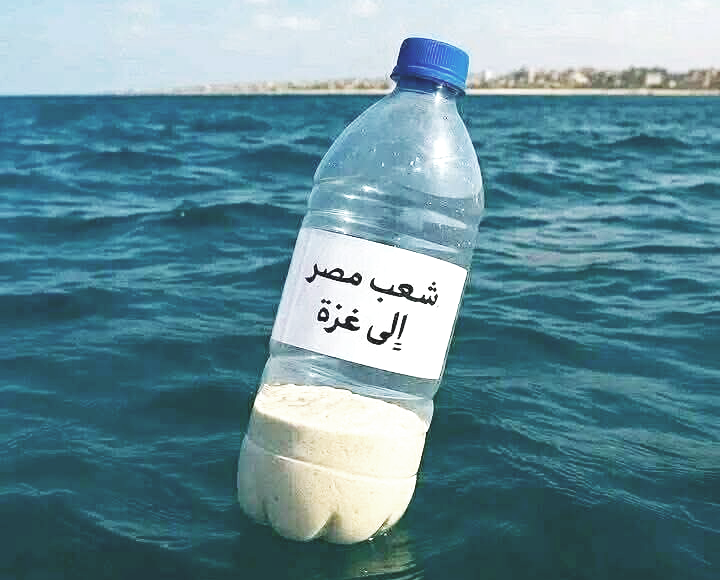
The crisis in Gaza has reached devastating levels, forcing citizens of Egypt to take an extraordinary action. In a desperate effort, people from coastal cities like Port Sa’eed and Dimyat are filling empty bottles with food supplies such as grains, rice, lentils, and baby formula, and releasing them into the Mediterranean Sea, hoping ocean currents will carry them to the shores of Gaza. This initiative named “From Sea to Sea: A Bottle of Hope for Gaza” portrays the desperate situation in Gaza and the determination of individuals to help when official aid routes are blocked.
The Crisis in Gaza
Gaza, home to 2.1 million people, is facing a severe humanitarian crisis. Since the atrocities of Israel escalated in October 2023, the tightened blockade has severely limited the flow of food, water, fuel, and medical supplies. This has led to widespread starvation. The World Health Organization reports that Gaza is experiencing mass starvation caused by human actions, with children dying from malnutrition at an alarming rate. The United Nations states that nearly one-third of Gaza’s population goes without food for days, and over 18,000 children have been hospitalized for acute malnutrition in 2025 alone. Before the conflict, 500 aid trucks entered Gaza daily. Now, the average is just 28.
The blockade has also made aid distribution extremely dangerous. The so-called “Gaza Humanitarian Foundation”, backed by the U.S. and Israel, has taken over from UN-led systems. But its distribution sites are nothing short of “death traps” as stated by UN officials themselves. Since May 2025, over 1,000 Palestinians have been killed by Israeli forces while trying to access food at these sites, with hundreds more injured. The ongoing bombardment has destroyed hospitals, schools, bakeries, and water systems, leaving Gaza’s people entirely reliant on external aid. Human rights groups, including Amnesty International, have accused Israel of using starvation as a weapon of war. For Gazans, the choice is sheer horror: risk death to reach aid or die of hunger.
The Egyptian Effort: Sending Food by Sea
In response to this tragedy, Citizens of Egypt in coastal cities like Port Sa’eed and Dimyat have started a basic initiative. Moved by the condition of starving children and families unable to feed their loved ones, they are filling one- and two-liter plastic bottles with dry foods like rice, lentils, flour, and baby formula. These containers are sealed tightly to float and released about 4 kilometers offshore, with the hope that they will drift to Gaza.
This effort has gained a lot of attention on social media, where photos and videos show people launching the containers. They release them at a 60-degree angle to the northeast to align with the Mediterranean’s eastward currents. The initiative has inspired others in Libya, Tunisia, Algeria, and Morocco to join in. While some view it as a “symbolic act”, for those involved it is a serious attempt to bypass the blockade and deliver aid directly to Gaza’s people.
The Science of the Sea Journey
The journey from Egypt’s coast to Gaza depends on ocean currents and wind. The distance from Port Sa’eed or Dimyat to Gaza’s 40-kilometer coastline is about 120 to 150 kilometers. The eastern Mediterranean’s surface currents flow eastward at an average speed of 0.6 to 0.8 kilometers per hour. At this pace, the containers could reach Gaza in 72 to 96 hours, if they stay on course that is.
Several factors affect the journey. The containers must be released in alignment with the eastward currents, as currents closer to shore could pull them in the wrong direction. Wind plays a role too. Northerly or westerly winds could help push the containers toward Gaza, while southerly winds might divert them. The containers are designed to float by leaving air inside. Rough seas or damaged seals/caps could cause them to sink or break. While the bottles could reach Gaza, the journey is uncertain, and the chances of significant amounts arriving intact are low. Even so, the effort is undoubtedly worthwhile. This is about people dying of starvation. A single bottle that reaches Gaza’s shore could offer temporary relief, even if only to one starving soul.
Why This Effort Matters
This initiative is a desperate attempt to deliver aid to Gaza’s starving population when governments and international systems have failed. The blockade has left thousands of tons of food and supplies stuck in warehouses in Egypt and Jordan, unable to reach those in need. This effort shows the frustration and resolve of ordinary people who refuse to stand by while the Muslims of Palestine suffer.
For Muslims, this initiative carries Islamic teachings which stress the duty to help those in need and stand with the oppressed. The Prophet Muhammad (peace be upon him) said, “The believers, in their mutual kindness, compassion, and sympathy, are like one body. When one part of it suffers, the whole body responds with sleeplessness and fever.” This effort embodies that principle, as these ordinary people of Egypt has acted to ease the suffering of their brothers and sisters in Gaza.
Some may argue that the odds of the containers reaching Gaza are slim, but dismissing the effort misses its significance. It is an act of defiance against injustice and a refusal to accept inaction. It draws attention to the failure of the so-called governments of Islamic countries to protect Gaza’s. The bottles drifting across the sea show that average Muslims can take bold steps to support other Muslims, even in the face of overwhelming challenges. It is truly remarkable to witness this level of faith where one goes to great lengths to feed the people of this Ummah as if they were their own family and children.
Conclusion
Gaza’s population faces starvation, violence, and displacement under a suffocating blockade, yet global efforts to deliver aid have fallen short. By launching food-filled containers into the sea, the people of Egypt are making a practical attempt to break through the restrictions while sending a powerful message of solidarity. Though the sea journey is uncertain, the effort’s true value lies in its ability to inspire action, raise awareness, and challenge the status quo. For those committed to Islamic activism, this initiative is a reminder of our responsibility to seek justice and support the oppressed. The containers may ride the waves to Gaza, but it is the collective effort of the Muslim Ummah that must ultimately lift the blockade and bring relief to Gaza’s suffering people.